- Your cart is empty
- Continue Shopping


ecommerce business
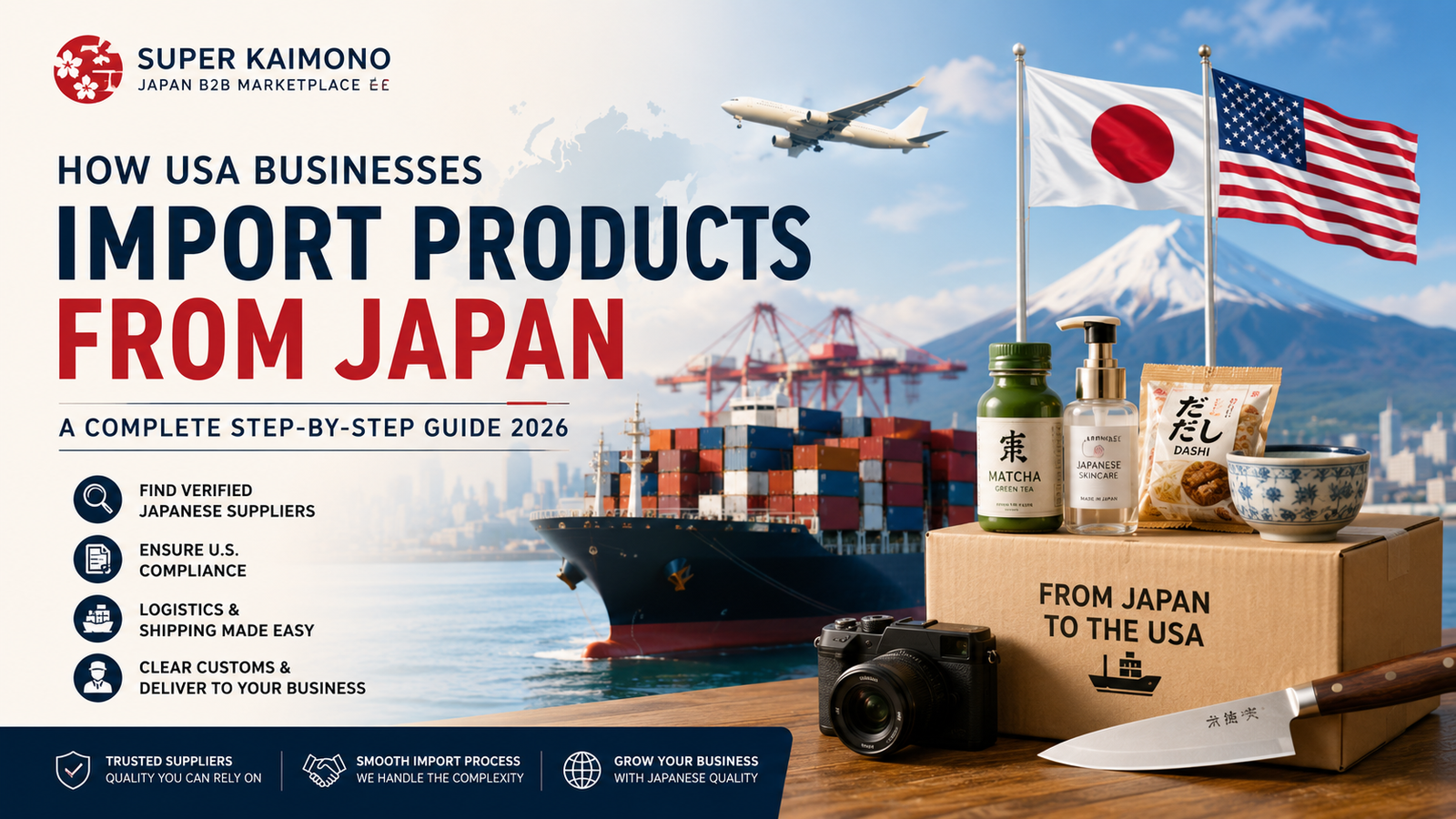
How USA Businesses Import Products from Japan
-
By Ekram Hossen
- Posted on
- 0 comments
If you run a retail business, an e-commerce store, or a wholesale distribution operation in the United States, importing products from Japan is one of the most strategically sound sourcing decisions you can make in 2026.
The United States is one of Japan’s largest trading partners. Every year, American businesses import billions of dollars worth of Japanese goods — from beauty and skincare products and specialty foods to electronics, health and wellness products, and home goods. The reason is consistent: American consumers trust Japanese quality, and that trust translates directly into stronger retail margins for importers.
But knowing that you should import from Japan and knowing how to do it correctly are two very different things. The import process involves supplier research, product compliance with U.S. regulations, customs clearance, freight logistics, and trade documentation — all of which must be handled properly to avoid costly delays, penalties, or rejected shipments.
In this guide, we walk through exactly how USA businesses import products from Japan in 2026 — step by step, from finding your first verified supplier to clearing customs and getting products onto your shelves.
📌 Key Takeaways
- The USA–Japan trade relationship is one of the strongest in the world, supported by decades of regulatory alignment and mutual trade agreements.
- USA businesses can import Japanese products through direct manufacturer relationships, import agents, or dedicated Japan B2B marketplaces like Super Kaimono.
- Key compliance requirements for the U.S. market include FDA regulations (for food, cosmetics, and health products), FCC standards (for electronics), and CBP customs procedures.
- Japanese products are typically already manufactured to standards that align with U.S. import requirements, making the compliance process smoother than with many other sourcing countries.
- A Japan B2B marketplace is the most efficient entry point for U.S. buyers who want verified suppliers, trade protection, and professional import support.
1. Why USA Businesses Choose Japan as a Sourcing Partner
Before getting into the mechanics of importing, it is worth understanding why Japan specifically is the right sourcing choice for U.S. businesses — particularly when alternatives like China or Southeast Asia are often discussed as lower-cost options.
The answer comes down to three overlapping factors: quality alignment, market positioning, and consumer trust.
Quality That Meets U.S. Consumer Expectations
American consumers — particularly in the premium, wellness, and specialty retail segments — have growing expectations around product safety, ingredient transparency, and manufacturing standards. Japanese products are produced under the Japanese Industrial Standards (JIS) framework, and manufacturers often hold additional certifications including ISO 9001, GMP (Good Manufacturing Practice), and ISO 22000 for food safety.
These certifications do not just signal quality in general — they map directly onto U.S. import requirements enforced by agencies such as the FDA and CPSC (Consumer Product Safety Commission). When you source from a certified Japanese manufacturer, much of the compliance groundwork is already done.
“Made in Japan” Commands a Retail Premium in the USA
In virtually every product category, “Made in Japan” carries a meaningful retail price premium in the American market. This is especially true in beauty and skincare (driven by the J-Beauty movement), specialty food and beverage, electronics, and cookware. For wholesale buyers, this premium at the retail stage directly improves profit margins — even when the wholesale purchase price is higher than Chinese equivalents.
The USA–Japan Trade Relationship Is Stable and Favorable
The U.S.–Japan Trade Agreement, which came into effect in January 2020, reduced or eliminated tariffs on many categories of Japanese goods imported into the United States. This has made Japanese products increasingly cost-competitive for U.S. importers while maintaining the quality advantage that makes them valuable to consumers.
2. What U.S. Businesses Most Commonly Import from Japan
Understanding which product categories have the strongest import track record in the U.S. market helps new importers make smarter sourcing decisions. The following are the highest-demand Japanese import categories among American wholesale buyers:
🌸 Beauty & Skincare (J-Beauty)
The Japanese beauty industry has cultivated a global following, and the U.S. market is among its strongest. Products like double-cleansing oils, hydrating toners, sunscreen, collagen supplements, and fermented skincare actives are actively sought by American beauty retailers, spas, and online sellers.
Japanese beauty products are formulated to international standards, making FDA compliance for cosmetics relatively straightforward. Browse Japanese beauty products →
🍜 Specialty Food & Beverage
The U.S. has one of the world’s most developed markets for Japanese food products. Everything from premium soy sauces, mirin, matcha, and rice vinegar to Japanese snacks, teas, and functional beverages has a dedicated and growing consumer base in the United States.
Japanese food manufacturers follow HACCP (Hazard Analysis and Critical Control Points) standards, which aligns well with FDA food safety requirements. Browse Japanese food products →
📱 Electronics & Gadgets
Japan remains a global leader in consumer electronics, personal care devices, and precision instruments. For U.S. importers, Japanese electronics often come with FCC-compatible specifications and international safety certifications, reducing the compliance burden significantly. Browse electronics →
🏠 Kitchen Supplies & Home Goods
Japanese kitchenware — high-grade knives, ceramic cookware, precision cutting boards, and space-efficient storage solutions — has a devoted following among American home cooks and premium kitchen retailers. These products pair quality manufacturing with minimalist design aesthetics that resonate strongly with the U.S. market. Browse kitchen supplies →
💊 Health, Wellness & Personal Care
Japanese health products including nutritional supplements, oral care items, personal hygiene products, and wellness devices are increasingly popular in the U.S. market, driven by consumer interest in preventative health and clean-label ingredients. Browse health & medical products →
💇 Hair Care & Styling
Japanese hair care brands have built lasting loyalty among U.S. salons, beauty supply stores, and online beauty platforms. Their advanced formulations combining botanical ingredients with modern science are a strong commercial proposition in the premium hair care market. Browse hair care products →
3. The Four Main Methods USA Businesses Use to Import from Japan
There is no single correct way to source products from Japan. The right method depends on your business size, import experience, target product category, and budget. Here are the four primary approaches used by U.S. importers:
Method 1: Japan B2B Marketplace (Recommended for Most U.S. Buyers)
A dedicated Japan B2B marketplace like Super Kaimono is the most accessible and safest entry point for U.S. businesses importing from Japan — especially for small and medium-sized businesses that do not yet have established supplier contacts in Japan.
These platforms offer:
- Verified supplier profiles with business registration and export credentials confirmed
- A curated product catalog across 80+ categories from Japanese manufacturers
- Trade Assurance protection covering buyers from payment through delivery
- Direct communication with suppliers in English
- Transparent pricing, MOQ details, and shipping options
For any U.S. buyer who wants to import Japanese products without the complexity and risk of cold-approaching unknown manufacturers, a Japan B2B marketplace removes most of the friction. You can browse verified Japanese suppliers on Super Kaimono immediately.
Method 2: Direct Manufacturer Relationship
Larger U.S. importers sometimes build direct relationships with Japanese manufacturers — bypassing any intermediary marketplace. This approach typically yields the best wholesale pricing and most flexible production arrangements, but requires more groundwork: identifying manufacturers through trade directories or Japan trade fairs, conducting factory audits, and navigating supplier communication directly.
Direct manufacturer relationships are highly effective once established, but they require significant trust-building and are generally more practical for businesses already doing consistent import volume.
Method 3: Japanese Trading Companies (Sogo Shosha)
Japan’s major trading companies — including Mitsubishi Corporation, Mitsui, and Sumitomo — can act as intermediaries between U.S. buyers and Japanese manufacturers. Trading companies handle export logistics, documentation, and quality control on behalf of both parties.
This approach is typically used by large-volume importers who need multi-product sourcing across many manufacturers simultaneously. Trading companies add a fee layer, which affects margins, but they also provide a high degree of operational reliability.
Method 4: U.S.-Based Import Agents
Some U.S. businesses use domestic import agents or sourcing consultants who specialize in Japan. These agents have existing relationships with Japanese suppliers and can negotiate on behalf of U.S. buyers. They are particularly useful for businesses entering the Japanese sourcing market for the first time who want hands-on guidance.
Comparison at a Glance:
| Method | Best For | Setup Speed | Cost Efficiency | Risk Level |
|---|---|---|---|---|
| Japan B2B Marketplace | SMBs, new importers | ⚡ Fast | ✅ High | 🟢 Low |
| Direct Manufacturer | Large volume buyers | 🐢 Slow | ✅✅ Very High | 🟡 Medium |
| Trading Companies | Multi-product, large orders | 🐢 Slow | 🟡 Medium | 🟢 Very Low |
| U.S. Import Agents | First-time importers | ⚡ Fast | 🟡 Medium | 🟢 Low |
4. Step-by-Step: How the Import Process Works for U.S. Businesses
Regardless of which sourcing method you use, the import process for bringing Japanese products into the United States follows a consistent set of steps. Here is the complete workflow:
Step 1 — Identify and Verify Your Japanese Supplier
Start by identifying suppliers who match your product requirements and verify their credentials before proceeding. On a platform like Super Kaimono, verification is built into the listing process — you can confirm a supplier’s business registration, export experience, and product certifications directly from their profile.
Key verification checkpoints:
- Japanese business registration number
- Relevant product certifications (ISO, GMP, JIS, HACCP)
- Export history and references
- English communication capability
- Experience with U.S. customs documentation
Step 2 — Request and Evaluate Product Samples
Before placing any wholesale order, request product samples. This is non-negotiable — especially for regulated product categories like food, cosmetics, and health supplements, where what you sell must exactly match what was approved.
Sample evaluation should include:
- Physical product quality (materials, finish, packaging)
- Label and ingredient information (does it comply with U.S. requirements?)
- Shelf life and storage requirements
- Consistency with the product description and photos
Step 3 — Understand U.S. Import Regulations for Your Product Category
This is the step that catches many first-time importers off guard. The United States has specific import regulations that vary by product category, enforced by different federal agencies:
🏥 FDA (Food and Drug Administration) Governs food, beverages, dietary supplements, cosmetics, and medical devices. Japanese products in these categories must comply with FDA labeling requirements, ingredient restrictions, and facility registration rules. Many Japanese manufacturers already meet FDA-compatible standards, but label translations and reformatting for U.S. requirements may be needed.
📡 FCC (Federal Communications Commission) Governs electronics, wireless devices, and radio-frequency products. Japanese electronics often come with FCC certification or can be tested for compliance relatively easily.
🛡️ CPSC (Consumer Product Safety Commission) Governs a wide range of consumer products including toys, children’s products, home goods, and personal care devices. Products must meet U.S. safety standards and testing requirements.
🛃 CBP (U.S. Customs and Border Protection) All imports enter the U.S. through CBP. You will need to file an entry declaration, pay applicable import duties, and provide accurate customs documentation for every shipment.
Working with a licensed U.S. customs broker — especially for your first few shipments — is highly recommended. They handle CBP documentation, calculate duties, and help ensure your shipments clear without delays.
Step 4 — Negotiate Pricing, MOQ, and Payment Terms
Once you have validated your supplier and confirmed product compliance, negotiate the commercial terms of your wholesale order:
- Wholesale unit price (and volume discount thresholds)
- Minimum Order Quantity (MOQ) — Japanese manufacturers often accommodate smaller initial orders for new relationships
- Payment terms — common options include T/T (telegraphic transfer), Letter of Credit (LC), and platform-based escrow through Trade Assurance
- Lead times — Japanese manufacturers are known for precision scheduling; confirm production and shipping timelines clearly
- Packaging requirements — U.S. retail packaging typically requires English-language labeling, specific font sizes for ingredient lists, and nutrition/supplement facts panels
Step 5 — Arrange International Freight and Logistics
Japan to USA shipping typically uses three main methods depending on order size and urgency:
✈️ Air Freight Best for smaller, high-value shipments or time-sensitive orders. Transit time: approximately 3–7 days from Japan to major U.S. ports. Cost: higher per kg, but efficient for premium products where speed matters.
🚢 Sea Freight (LCL or FCL) Best for large bulk orders where unit cost control is the priority. Transit time: approximately 14–21 days from Japan to West Coast U.S. ports (Los Angeles/Long Beach); 25–35 days to East Coast ports. Cost: significantly lower per unit than air freight.
📦 Courier (DHL, FedEx, UPS) Best for product samples and small test shipments. Fastest transit, but costs are high for commercial quantities.
Most experienced Japanese exporters work with established international freight forwarders and can recommend logistics partners they have existing relationships with. Confirm Incoterms (such as FOB, CIF, or DDP) clearly in your purchase agreement, as these determine who bears responsibility for freight costs, insurance, and customs fees. Review the Super Kaimono shipping policy for more details on delivery options.
Step 6 — Complete U.S. Customs Clearance
When your shipment arrives at a U.S. port, it must clear CBP customs before it can be delivered. The key documents required are:
- Commercial Invoice — itemizing the goods, declared value, and country of origin
- Packing List — detailed breakdown of contents, weights, and dimensions
- Bill of Lading (sea) or Airway Bill (air) — the shipping contract between shipper and carrier
- Certificate of Origin — confirming the goods are manufactured in Japan
- Import Entry Declaration (CBP Form 3461 or 7501)
- Product-specific compliance documentation (FDA registration, FCC certificate, etc. where applicable)
For shipments valued over $2,500, a formal customs entry is required and your customs broker will file this on your behalf. Import duties are calculated based on the Harmonized Tariff Schedule (HTS) code assigned to your product — duty rates vary significantly by category, so confirm your product’s HTS code early in the planning process.
Step 7 — Build the Supplier Relationship for Long-Term Advantage
The initial import is just the beginning. Japanese business culture places enormous value on long-term relationships — a concept known as keiretsu (networked business relationships). Suppliers who trust their overseas buyers regularly offer:
- Preferential pricing as order volume grows
- Early access to new product lines before general release
- Priority production scheduling during peak seasons
- Custom labeling, OEM manufacturing, and private label options
- Flexible MOQ adjustments for loyal, consistent buyers
Maintaining professional communication, honoring payment terms, and providing feedback on product performance builds the kind of trust that unlocks these advantages. Visit our FAQ page for guidance on building strong supplier relationships through Super Kaimono.
5. U.S. Import Duties and Tariff Considerations for Japanese Products
One of the most common questions U.S. importers ask is: how much will I pay in import duties?
The answer depends on your product’s HTS code, but here is a general overview of duty rates for common Japanese import categories in 2026:
| Product Category | Typical U.S. Duty Rate | Notes |
|---|---|---|
| Cosmetics & Skincare | 0% – 6.5% | Most formulations duty-free or low duty |
| Food & Beverage | 0% – 6.4% | Varies by product type; some specialty items higher |
| Electronics | 0% – 3.7% | Most consumer electronics duty-free |
| Kitchen Supplies | 0% – 8.5% | Metal goods may have higher rates |
| Health Supplements | 0% – 6.4% | Supplement capsules/tablets vary |
| Textiles & Bags | 6% – 17% | Higher duty category; check HTS carefully |
| Toys | 0% – 6.8% | Most duty-free under U.S.–Japan trade terms |
Note: Duty rates are indicative. Always verify your specific product’s HTS code with a licensed customs broker before finalizing import costs.
The U.S.–Japan Trade Agreement has reduced duties on many categories, and additional reductions continue to phase in. For the most current rates, consult the USITC Harmonized Tariff Schedule or work with a customs broker who specializes in Japan imports.
6. Common Mistakes USA Businesses Make When Importing from Japan (And How to Avoid Them)
Even experienced importers encounter pitfalls. Here are the most common mistakes — and how to avoid them:
❌ Skipping product sample evaluation Ordering bulk without testing samples first is one of the most expensive mistakes in wholesale importing. Always test samples for quality, compliance, and retail presentation before committing to a full order.
❌ Underestimating FDA compliance requirements Many first-time importers of Japanese food, cosmetics, or supplements discover compliance gaps only when shipments are held at the U.S. port. For FDA-regulated products, verify labeling requirements and facility registration before placing your order.
❌ Not confirming Incoterms clearly Misunderstandings about who pays for freight, insurance, and customs fees are a frequent source of dispute. Always specify Incoterms explicitly in your purchase agreement.
❌ Choosing the wrong freight method Sending large bulk orders by air freight significantly inflates per-unit costs. Plan your freight method based on order size, product value, and urgency — not just convenience.
❌ Working with unverified suppliers The risk of fraud, product misrepresentation, or quality failure is much higher when sourcing from unverified suppliers. Always use platforms or processes that confirm supplier credentials before you commit funds. The Verified Supplier program on Super Kaimono addresses this risk directly.
❌ Ignoring HTS classification Using the wrong HTS code leads to incorrect duty payments — either overpaying or, worse, underpaying and facing CBP penalties. Consult a customs broker for correct HTS classification.
7. How Super Kaimono Supports USA Business Importers
Super Kaimono is specifically designed to make the Japan import process efficient, safe, and accessible for international wholesale buyers — including U.S. businesses importing for the first time.
Here is what the platform offers U.S. importers:
✅ Verified Japanese Suppliers — All suppliers are vetted for business registration, export credentials, and product certifications before listing. No guesswork about supplier legitimacy.
✅ 10,000+ Products Across 80+ Categories — From beauty and food to electronics and health products — the full range of Japan’s wholesale export catalog in one place.
✅ Trade Assurance Protection — Orders placed through the platform are protected from payment through delivery. For U.S. buyers concerned about cross-border transaction risk, this protection is a significant advantage. See full details on the FAQ page.
✅ Global Shipping Support — Super Kaimono suppliers are experienced exporters who work with international freight partners and can assist with documentation for U.S. customs clearance. Review the shipping policy for full details.
✅ Direct Supplier Communication — Message Japanese manufacturers directly through the platform, in English, with structured tools for requesting samples, discussing MOQ, and confirming order terms.
✅ 80+ Countries Served — The platform is built for international trade, with U.S. buyers being among the most active on the platform.
To get started, browse the Super Kaimono shop or explore verified supplier stores to find the right Japanese manufacturer for your business.
Frequently Asked Questions
Do USA businesses need an import license to import from Japan?
For most standard consumer goods, the United States does not require a general import license. However, certain regulated product categories — including food, pharmaceuticals, some medical devices, and firearms — require specific registrations or approvals from agencies such as the FDA or ATF. For most wholesale buyers importing Japanese beauty, food, electronics, or household products, no special import license is needed beyond standard CBP entry procedures.
How long does shipping from Japan to the USA take?
Air freight from Japan to major U.S. cities typically takes 3–7 days. Sea freight to West Coast ports (Los Angeles, Seattle) takes approximately 14–21 days; East Coast ports (New York, Baltimore) take 25–35 days. Courier services for small shipments typically take 3–5 business days.
What is the minimum order quantity for Japanese wholesale products?
MOQ varies by supplier and product category. Many Japanese manufacturers on Super Kaimono accommodate smaller initial orders for new buyers, particularly when establishing a new business relationship. As the relationship develops and order volumes grow, MOQs often become more flexible and pricing improves.
Are Japanese products FDA compliant for the U.S. market?
Japanese manufacturers generally produce to standards that align closely with FDA requirements, but label compliance — including English-language ingredient lists, nutrition facts panels, and specific FDA warning statements — typically requires adaptation for the U.S. market. For food and dietary supplements, facility registration with the FDA may also be required. Always verify compliance requirements for your specific product category before importing.
What import duties apply to Japanese products entering the USA?
Duty rates vary significantly by product HTS code. Many Japanese goods — including most electronics and cosmetics — attract low or zero duty rates under the U.S.–Japan Trade Agreement. Others, such as textiles and certain kitchenware, carry higher rates. Consult a licensed customs broker for accurate duty calculation for your specific products.
Can small U.S. businesses import from Japan profitably?
Absolutely. Many successful small businesses in the U.S. — including boutique beauty retailers, specialty food importers, online health stores, and kitchen goods sellers — are built on Japanese wholesale sourcing. The key is starting with a focused product selection, verifying suppliers carefully, and building the supplier relationship over time. Super Kaimono is specifically designed to make Japan-sourcing accessible for businesses of all sizes.
Japan’s Trusted B2B Marketplace
Ready to Start Importing Japanese Products into the USA?
Join thousands of international wholesale buyers who use Super Kaimono to discover, verify, and order from premium Japanese manufacturers across 80+ product categories — all with Trade Assurance protection and direct English-language supplier communication.
Browse Japanese Products | View Verified Suppliers | Start Selling on Super Kaimono
📰 Related Articles
- Why Japan is a Trusted Source for Bulk Product Sourcing in 2026
- Japan B2B Marketplace vs Alibaba: Which Is Better for Wholesale Buyers in 2026?
- How to Find Verified Japanese Wholesale Suppliers in 2026
- Step-by-Step Guide to Importing from Japan for Wholesale Buyers
- Super Kaimono FAQs — Buyer and Supplier Questions Answered
- Shipping Policy — How Products Are Delivered from Japan Worldwide
